
Arrest History in El Paso County
An arrest can create four records at once. The arresting agency writes an incident or arrest report. El Paso County Jail creates booking, custody, bond, hold, warrant, and release entries if the person enters the jail. District or County Court opens a case only after charges are filed. The Colorado Bureau of Investigation, or CBI, may receive a fingerprint-supported arrest cycle for its statewide criminal history. Each source has a different scope and update path.
The El Paso County Sheriff's Office, or EPSO, does not perform background checks. Its Records Unit releases available deputy reports and sheriff criminal-justice records. A Colorado Springs, Fountain, Monument, State Patrol, UCCS, or other agency report must be requested from the agency that created it. Likewise, a current jail entry cannot establish how the prosecutor later changed a charge or how the court resolved it. For that outcome, read the El Paso County criminal court case file.
Three El Paso Arrest Records
One El Paso County arrest often leaves a time-ordered trail. First, the agency report describes the time, place, alleged conduct, officer, and initial offense. Next, jail intake verifies legal papers, checks state and national systems, inventories money and property, takes identification photographs, screens medical needs, fingerprints the person, and verifies warrants. Later, the court file records the charge the prosecutor actually filed, hearings, pleas, disposition, and sentence.
Those stages explain why labels may differ. A booking charge is an allegation entered near the start. Prosecutor review can amend or decline it. A court may dismiss a count, accept a plea to another count, or enter an acquittal. CBI warns that its history only contains data it received and may omit a summons, ticket, or final disposition. A reader should preserve the report, booking, and case numbers because they connect the layers without treating them as the same document.
How to Look Up El Paso County Arrests
Use the narrowest official channel first. The free EPSO inmate search accepts either a last name or booking number and needs no account. It is a current-custody tool, not a full historical arrest index. For a reliable search, follow the record from custody to its creator and then to the court or state repository when the question calls for those layers.
- Search the EPSO roster by last name or booking number and open the booking detail.
- Confirm a time-sensitive bond, release, or court result with the Booking Desk at 719-390-2151.
- Request the incident or arrest report from EPSO Records only for a sheriff event; contact CSPD, Fountain, Monument, or the other arresting agency for its report.
- Check the El Paso Combined Courts record for filed or amended charges and the final disposition.
- Use CBI Internet Criminal History Check for a paid, Colorado-only name-based repository result, or the authorized fingerprint route for one's own identity-supported review.
No official public countywide active-warrant name search was found. Call El Paso Combined Court at 719-452-5000, option 6, and review the issuing case. A warrant shown on an inmate detail belongs to that current booking and does not turn the roster into a full warrant list.
The official inmate-search source shows how El Paso County exposes recent custody.
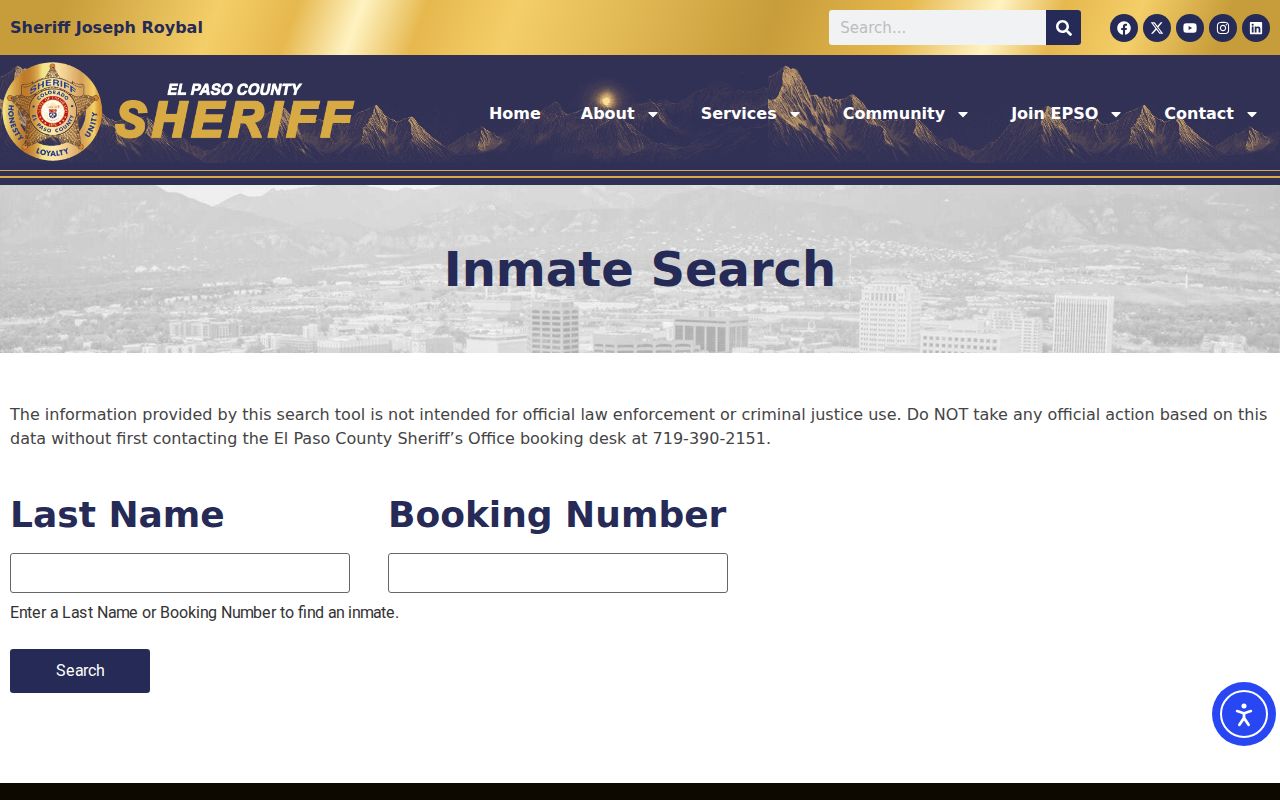
The screen's limited fields are a cue to verify the opened detail and call the Booking Desk when current status matters.
Inside El Paso Booking Detail
The result list displays a clickable booking number plus first, middle, and last name. The opened El Paso County booking record adds date of birth, eyes, hair, height, weight, sex, race, scars or marks, and the reported jail building or location. These are booking-system identifiers, not fixed facts. “Location” describes current custody placement, not the arrest scene.
Charge rows are court-oriented. They can show court date, court division, degree, court case number, bond type, bond amount, and release date. Holds appear by description and hold code. Warrants appear by number, description, and level. The public page does not render a mugshot, booking date or time, arresting agency, statute, charge narrative, officer, magistrate, or housing pod. No names or booking photos are republished here. A separately releasable report may contain more, but the public profile should never be read as though it does.
What an Arrest Record Shows
“Arrest record” is a broad label in El Paso County. The precise contents depend on whether the document came from the police agency, jail, court, or CBI. Ask for the named record instead of asking an office for “everything.”
| Agency report | May include report number, time, location, officer, alleged offense, and narrative, subject to CCJRA withholding and redaction. |
|---|---|
| Booking identity | Booking number, name, physical identifiers, and current reported custody location. |
| Court routing | Court date, division, case number, and degree fields when populated. |
| Release data | Bond type, bond amount, release date, separate holds, and returned warrants. |
| Booking photo | Not displayed by the EPSO public search. A custodian may assess a separate lawful request. |
| State history | CBI's Colorado repository view, limited to submitted and publicly releasable information. |
A blank release field or missing charge narrative is not proof that the underlying event did not occur. It means the public interface does not supply that fact in that place.
El Paso Sheriff Report Requests
EPSO Records is at 27 E. Vermijo Avenue, Colorado Springs, CO 80903. Records staff can be reached at 719-520-7177 or shrrecordsrelease@elpasoco.com. The counter is open weekdays from 8:00 a.m. to 4:30 p.m., excluding federal holidays, while payments end at 4:00 p.m. Supply a case-report number when possible, along with incident date and time, location, incident type, involved names, deputy name, and a working phone number.
EPSO Records Unit
27 E. Vermijo Avenue
Colorado Springs, CO 80903
719-520-7177
Weekdays, 8:00 a.m.-4:30 p.m.
The standard report charge is $8 for review, redaction, and up to ten pages, then $0.25 for each later page. Broader administrative CORA work is $32 per hour after the first free hour. EPSO aims for a response within 72 hours, though some requests take up to ten days. Criminal-justice records fall under the Colorado Criminal Justice Records Act, or CCJRA, so release can involve discretion and redaction.
The Sheriff's records and video request page provides the official forms, payment paths, and scope rules.
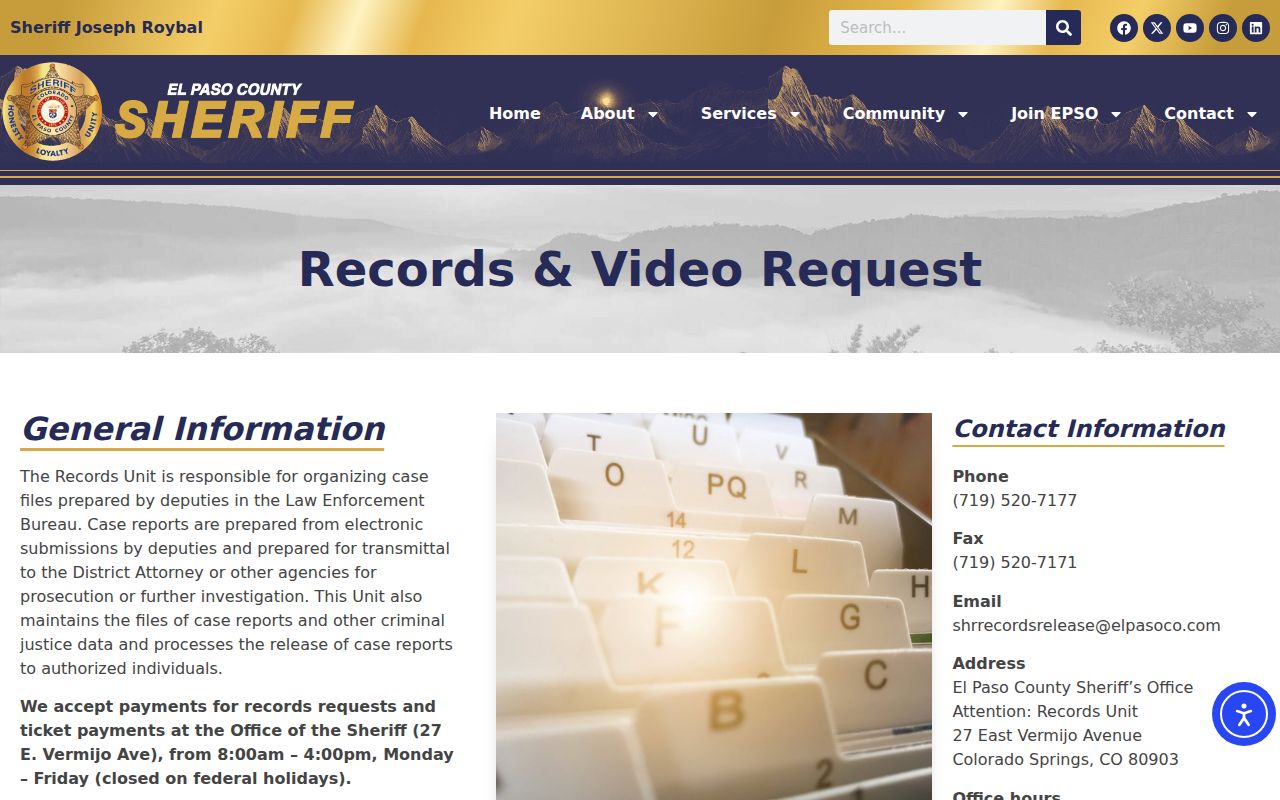
This source is the right starting point for an EPSO deputy report, but not for a city police report or a court pleading.
Recent Arrests and Booking Logs
El Paso County publishes a searchable current inmate roster rather than a mugshot gallery. Search results can disappear after release or transfer. A person might also be absent because of citation and release, a spelling variation, a city event that did not produce county custody, or a transfer to the Colorado Department of Corrections. In May 2025, EPSO reported that 139 sentenced people were awaiting CDOC beds, which shows why a sentenced person may remain in county results for a time.
Use 719-390-2145 for a verification-of-incarceration letter on weekdays from 9:00 a.m. to 5:00 p.m. The jail at 2739 E. Las Vegas Street handles booking and custody, while the Vermijo records counter handles sheriff reports. The official inmate-services page explains bonds, mail, visits, funds, and property channels that may matter after locating a booking.
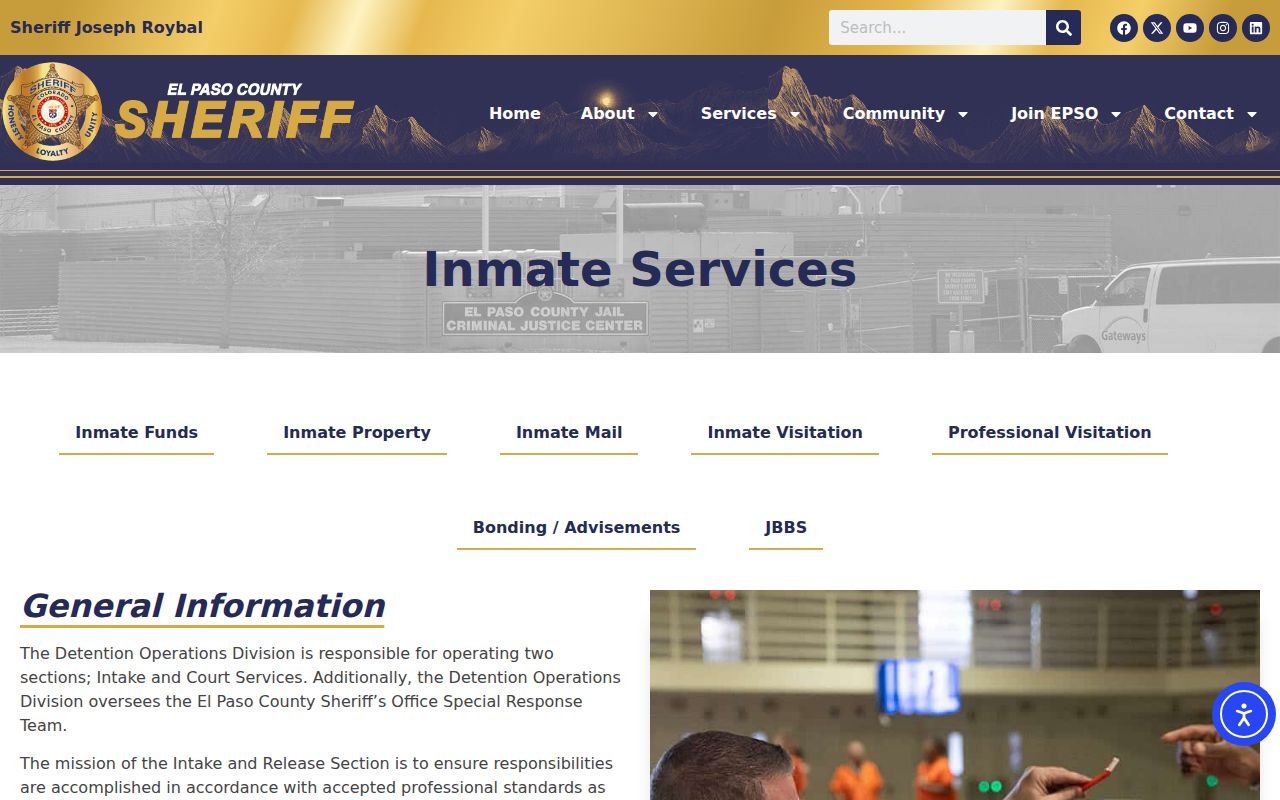
Those services relate to current custody and should not be confused with proof of a charge or conviction.
Route El Paso Arrest Reports
Agency ownership is a common trap. CSPD Records and Identification operates at 705 S. Nevada Avenue and uses its Accela request portal. Its account workflow moves from New Request to record type, search criteria, acknowledgment, checkout, receipt, and an attachment download. Fountain Police Records, at 222 N. Santa Fe Avenue, accepts drop-off, email, or fax requests; emailed requests require photo identification. Monument publishes its own Record Release Form. State Patrol and campus agencies also retain their own files.
An EPSO jail booking does not transfer a CSPD or Fountain narrative into the Sheriff's Records Unit. Request the narrative from the arresting agency, use the county jail for custody facts, and use Combined Courts for the filed case. That three-stop method prevents both false negatives and duplicate charges from being mistaken for separate events.
Sealing El Paso County Arrest Records
Colorado allows sealing for qualifying arrests, non-convictions, and convictions. Some eligible non-conviction records seal automatically, while others require a filing in the court that holds the case. Acquittals on all counts, completed diversion after filing, a completed deferred judgment with dismissal, and a vacated conviction can qualify under current court guidance when all conditions are met.
After an order, make sure it reaches CBI and then review one's own criminal history. Public access can change at different speeds across the arresting agency, court, and repository. Sealing restricts public visibility, but it does not mean the event vanishes for every lawful government purpose.
Arrests vs Convictions
An El Paso County arrest proves that an enforcement event was recorded, not that guilt was found. Only the court can enter a conviction. The distinction matters when a booking charge changed, prosecutors filed no case, a count was dismissed, or a trial ended in acquittal.
| Arrest Record | Conviction Record |
|---|---|
| Created by the arresting agency and possibly the jail. | Created by District, County, or Municipal Court. |
| Shows an allegation, booking, custody, or release event. | Shows a court finding or accepted guilty plea. |
| Lives with the agency, EPSO jail, and possibly CBI. | Lives in the court file and may flow to CBI. |
| May end in release, no filing, dismissal, or acquittal. | May lead to sentence, appeal, or qualifying sealing. |
Note: An arrest is not proof of guilt, and a booking entry must never be used as though it were a conviction.
Colorado sealing can change public visibility for qualifying arrests, non-convictions, and convictions. It does not erase every lawful government record. A person reviewing their own history should obtain the disposition from the filing court, send a sealing order or correction material to CBI when needed, and verify the result through their own CHRI.