
How to Check Criminal History in Monument
Start with the document, not a person-search assumption. A Monument police report, county jail entry, municipal summons, state-court file, and CBI history come from separate custodians. Use the route that created the item.
- Use the official Monument Police Record Release Form for a police report or listed official-action record.
- Give requester and contact information, incident or case identifiers, a useful description, delivery choice, payment details, and signature where the form calls for them.
- For a citation, read the named court and address. Contact Monument Municipal Court only when the summons routes there.
- Use EPSO for current county custody and the Fourth Judicial District for a filed state case.
- Use CBI ICHC for a statewide Colorado repository view, not as a replacement for the town report.
The official PDF did not expose every required or optional marking during text extraction. Do not assume that an unseen field is mandatory. Follow the live form and ask the town when a field is unclear.
Monument Record Form Field Guide
The Monument Police Record Release Form is the direct town route. It includes requester and contact identity, a Police Report choice, incident or case facts, a description, delivery and payment areas, and a signature area. Exact requiredness is only partly visible from the extracted official PDF, so the form itself controls.
Write enough to identify one Monument event: date, approximate time, location, involved name, officer or report number if known, and the record wanted. A narrow description helps the custodian distinguish a police report from an official-action entry or a record controlled by a court order.
Note: The form’s own limits matter more than a generic police-record checklist.
The Monument Police Department
Monument Police creates reports for incidents it investigates inside its jurisdiction. The Municipal Court and Police main directory phone is 719-481-3253. The town record is not an EPSO report, Fourth Judicial District file, or CBI history. If another agency handled the event, request its file instead.
The Town of Monument site is the official municipal source.

That local context is important in the Tri-Lakes area, where exact location and response can point to Monument Police, EPSO, Colorado State Patrol, or another agency.
The release form refers to official-action records and to denials when a court order prohibits release. Basic arrest or official-action facts may receive different treatment than a detailed investigative narrative. Ask for the precise item and read any stated denial basis.
Monument Police Excludes Accident Reports
The strongest Monument-specific rule is plain: the MPD form says the department does not provide traffic accident reports. A broad instruction to ask Monument Police for every police report would therefore be wrong. First identify who investigated the crash and which report system that agency uses.
Check the crash exchange, citation, officer information, location, and agency markings. An Interstate 25 incident may involve Colorado State Patrol. A nearby county-road event may involve EPSO. The fact that the event occurred near Monument does not by itself make MPD the custodian.
If the request concerns a police incident rather than a traffic accident, the Monument form may still be the right route. Describe the record accurately so town staff do not have to infer which product is sought.
Arrests and Bookings in Monument
A Monument arrest can lead to an El Paso County Jail booking. EPSO then maintains the booking number, physical identifiers, custody location, court and bond entries, holds, warrants, and release data shown in its system. Monument Police retains its own report. County custody does not transfer ownership of the police narrative.
Search the EPSO inmate portal by last name or booking number. Call Booking at 719-390-2151 for time-sensitive custody facts. The public detail does not display a mugshot, booking time, arresting agency, officer, narrative charge description, or statute. Request the MPD report and the named court file to fill those different needs.
Monument Criminal Records Amid Growth
The official Census profile gives Monument a 2024 estimate of 13,408, up 28.9 percent from the 2020 estimate base of 10,399.
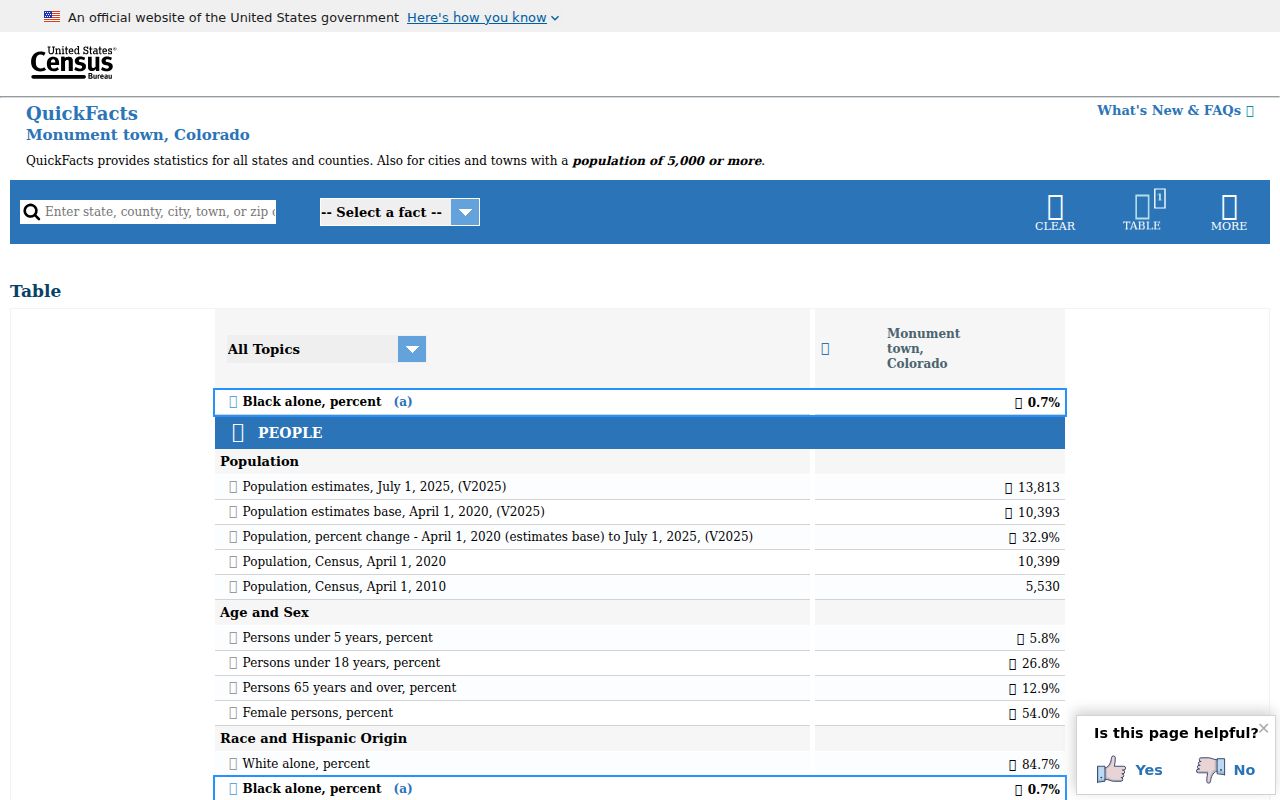
Rapid growth makes clear record routing useful in the Tri-Lakes area, but it is not evidence of more crime. Population must never be used to infer conduct by a Monument resident.
The practical result is a need to keep town, county, and state sources distinct. A growing town still does not create one unified criminal-history file.
Monument Municipal Court Records
Monument Municipal Court administers town cases. Some summonses written by Monument officers are instead filed in El Paso County Court. Read the face of the citation for the court, address, date, and case details. Do not assume the issuing officer’s badge fixes the destination.
The official Monument Municipal Court page identifies the town court and its jurisdiction.
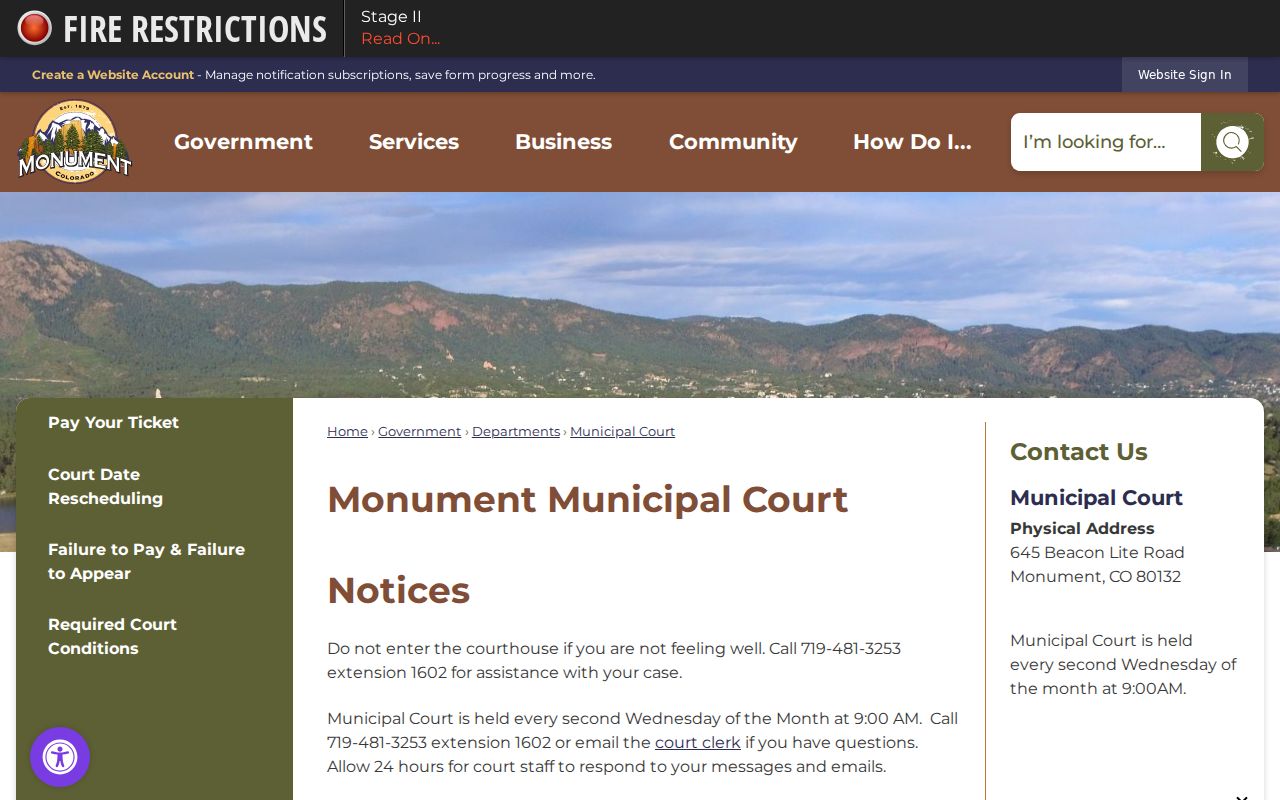
Use the court page and 719-481-3253 as direct fallbacks. A public stable name-based town search was not documented, so phone and counter confirmation are better than inventing an online portal.
| Court Name | Monument Municipal Court |
|---|---|
| Case Types Heard | Town cases; some Monument officer summonses instead name El Paso County Court |
| Case Lookup Channel | Official court page, directory phone, and clerk counter; no documented public name search |
| What the Docket Shows | Town charge, hearings, plea or disposition, sentence, and payment activity when public |
| Copies & Fees | Ask the clerk for the current fee and exact public record |
Checking a Monument Summons
Look for the court name before searching. A town citation belongs with Monument Municipal Court. A citation directing the person to El Paso County Court belongs to the Fourth Judicial District channel. If the document is missing, give the issuing agency, date, name, and incident details to the appropriate clerk and ask whether that office can confirm a public case.
No result at Monument Municipal Court does not establish that the officer issued no citation. The paper may route to county court, the case may not yet be entered, or access may be restricted. A county search also cannot rule out a separate town matter.
Note: The citation face is a routing tool, not proof of the final outcome.
Where Monument Records End Up
MPD creates the town report. EPSO creates booking data when county intake occurs. The named municipal or county court creates its case file. Fingerprint-supported arrest and disposition data may later reach CBI, but reporting gaps and legal exclusions remain possible.
Record flow: Monument Police Department › El Paso County Courts › Colorado Bureau of Investigation, Biometric Identification and Records Unit
Use Monument for the recent police record, EPSO for custody, the court named on the summons for charges and outcome, and CBI for statewide history. The El Paso County criminal court cases resource covers county filing and document requests in more depth.
Monument Official-Action Records
Colorado law distinguishes records of official actions from the broader investigative file. An official-action record can identify a formal event in the justice process, while the narrative may include protected victim facts, witness details, investigative methods, or private data. Monument’s form also recognizes that a court order can prohibit release.
If the town denies all or part of a request, read the stated reason. A court-ordered restriction cannot be avoided by asking the police for the same barred material. When the question concerns a filed charge or disposition, the correct source is usually the named court rather than a larger demand to MPD.
Monument Reports Versus CBI Records
CBI ICHC costs $6 for each downloaded match and provides a Colorado-only name-based repository result. CBI recommends first name, last name, and date of birth; an SSN may narrow common-name results. The online product cannot be notarized. It may omit tickets, summonses, records not reported to CBI, sealed arrests, and public-excluded juvenile information.
A Monument report answers what town officers documented about one event. ICHC organizes fingerprint-supported arrest cycles and dispositions sent to the repository. When reviewing one’s own history, compare any questionable state entry with the MPD source and final court order. A mismatch may require correction at the office able to verify it.
Public Access Rules for Monument Records
MPD applies Colorado criminal-justice record law to its release decisions. Monument Municipal Court and the Fourth Judicial District apply court-access rules to their own files. Sealed matters, juveniles, victims, private identifiers, active investigations, and court-prohibited material may be absent or redacted.
Key Statutes:
Colorado Open Records Act, C.R.S. 24-72-200.1 through 206 governs general public records subject to exceptions.
Colorado Criminal Justice Records Act, C.R.S. 24-72-301 through 309 governs inspection and disclosure of criminal-justice records.
Chief Justice Directive 05-01 controls access, fees, exclusions, and corrections for Colorado court records.
A public arrest or charge remains an allegation until the court record shows the result. Verify the disposition before relying on an early entry.
Correcting a Monument Record
A wrong detail should be raised with the custodian that can prove the correction. Monument Police reviews its report. The court controls its docket and final order. CBI controls the statewide entry built from fingerprint and disposition reporting. Asking one office to rewrite another office’s file can delay a valid fix.
For an ICHC identity mismatch, CBI directs the subject to obtain the questioned history, mark the discrepancy, get a physical fingerprint card through a CABS vendor, complete the Record Challenge form, and submit the packet to the state unit. A missing outcome calls for official court or agency proof. After correction, review the downstream public record again.
This process differs from sealing. Correction fixes verified data; sealing restricts public access under Colorado law.
When Monument Outcomes Are Missing
A Monument court outcome can be correct while the statewide entry is incomplete. Obtain the official disposition from the court that handled the citation or charge. Use the court named on the summons, since Monument Municipal Court cannot certify an El Paso County Court result.
CBI may review the official proof under its repository process. Keep copies of the request, response, and corrected result so the path between the town, court, and state entry remains clear. A corrected repository entry does not change the separate Monument police narrative.