
Criminal Cases in El Paso County Courts
State-law felony cases belong in District Court. County Court handles state misdemeanors and traffic matters. Both operate in the Fourth Judicial District at the El Paso County Judicial Building, 270 S. Tejon Street in Colorado Springs. Municipal ordinance cases stay in the city court named on the summons. That split matters because a search at the wrong clerk can return nothing even when a case exists.
The Clerk's Office in Room S101 is the custodian of El Paso County criminal case records. It is open weekdays from 7:30 a.m. to 4:30 p.m., but a 2026 notice lists a 3:30 p.m. close every third Wednesday. The main line is 719-452-5000. The Fourth Judicial District court page is the official starting point for current contacts and local notices.
The official El Paso County trial-court source shows the court structure readers must use.
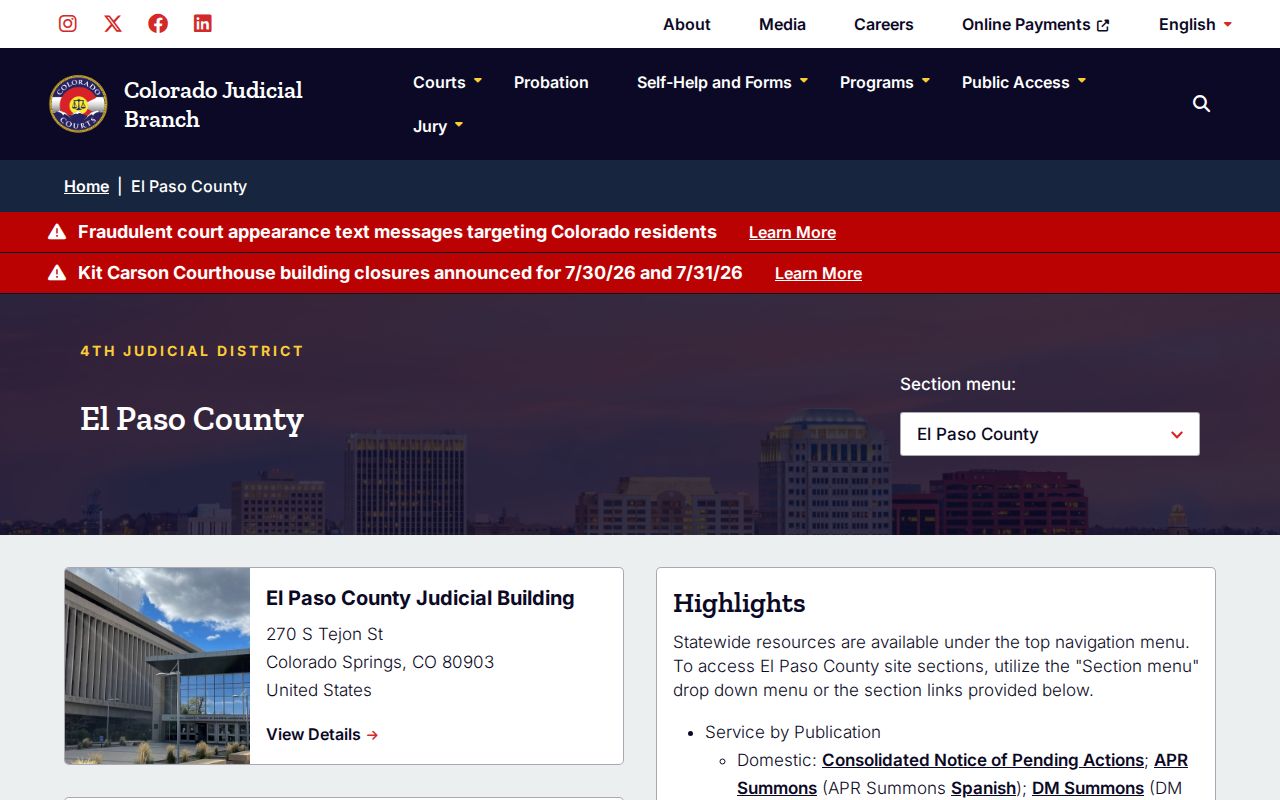
Its local page routes requests to the court that owns the criminal file.
Three El Paso County Record Counters
El Paso County criminal records are not kept at one universal counter. Tejon Street holds state court files and probation records. The Sheriff Records Unit at 27 E. Vermijo Avenue holds deputy reports and sheriff-created criminal-justice material. The jail at 2739 E. Las Vegas Street creates booking, custody, bond, hold, and release records. A court case request should go to Tejon, not to the sheriff simply because a deputy made the arrest.
District and County Court Clerk
270 S. Tejon Street, Room S101
Colorado Springs, CO 80903
719-452-5000
Weekdays, 7:30 a.m.-4:30 p.m.
Fourth District Probation
270 S. Tejon Street, Suite W200
Colorado Springs, CO
719-452-5900
Weekdays, 8 a.m.-5 p.m.
Probation may hold supervision material, but the sentence order and filed revocation motions remain court records.
How to Search El Paso County Case Records
Colorado Judicial provides an official request form rather than a free public document portal. Contracted systems may display a register of actions by name or case number, but pleadings and certified copies still come from the filing court. Start with the party's full name and optional date of birth. A known case number is the best key.
- Confirm whether the case is District, County, or Municipal Court.
- Use the party name, optional birth date, county, and case number if known.
- Select a register of actions or name search when the case number is unknown.
- Mark the exact documents needed, such as the Complaint or Information and Disposition or Sentence Order.
- Submit the request and pay any search, copy, certification, or retrieval charge the clerk quotes.
The Colorado Record/Document Request form captures the following fields. It also lets a requester narrow the order instead of paying for an entire file.
| Field | Format | Use |
|---|---|---|
| Full name | Text | Primary party search |
| Date of birth | Optional date | Distinguishes similar names |
| County | Selection | Routes to El Paso County |
| Case number | Text | Direct file key when known |
| Document type | Checkbox | ROA, Complaint/Information, disposition, sentence, or other named item |
| Certification | Selection | Requests a clerk-certified copy |
Note: No free Judicial Branch online document portal was found, so do not treat a commercial register-of-actions index as the complete court file.
The official request-form source illustrates the document-order route.
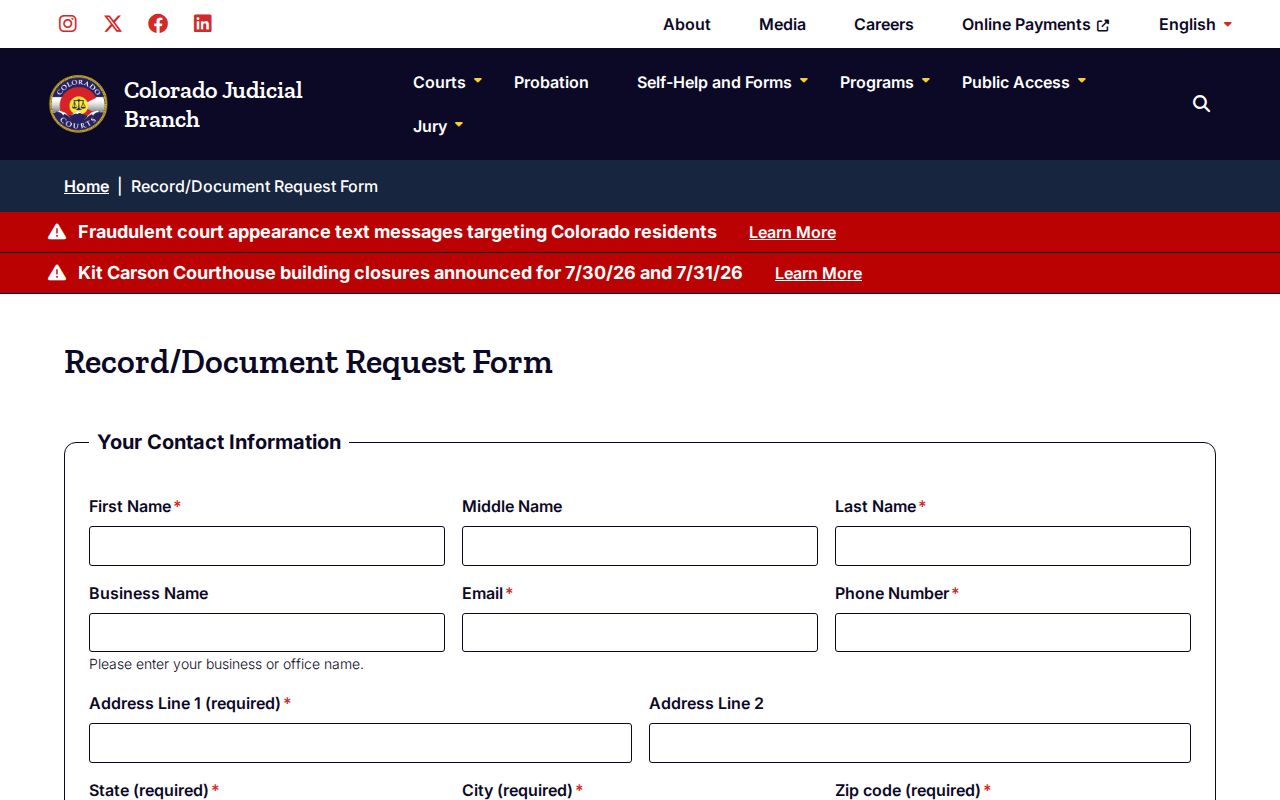
The form's document choices help separate a quick outcome request from a full-file order.
El Paso County Court Copy Costs
El Paso County criminal case searches and copies use the Judicial Branch schedule. A name search is $5 per name. Copies are $0.25 per page. Certification is $20 per document, while exemplification is $40 per document. Research, redaction, or compilation costs $32 per hour after the first hour, and off-site retrieval is charged at actual cost. Ask for an estimate when a request is broad.
| Service | Amount |
|---|---|
| Name search | $5 per name |
| Copy | $0.25 per page |
| Certification | $20 per document |
| Exemplification | $40 per document |
| Research, redaction, compilation | $32 per hour after first hour |
| Off-site retrieval | Actual cost |
A disposition or sentence order is often enough to prove the outcome. Ordering only that document can cut cost and review time.
What the El Paso County Case File Shows
A public register of actions is a chronological index, not the whole El Paso County criminal case file. It can list parties, charges, the court and division, event dates, minute orders, hearings, disposition, and sentence. The Complaint or Information shows what prosecutors filed. The disposition and sentence order provide stronger outcome proof than an arrest entry.
| Case number and court | The filing court, division, and unique file identifier. |
|---|---|
| Charging document | Complaint or Information, filed charges, statute, and charge class. |
| Docket entries | Hearings, minute orders, motions, pleas, and other dated events. |
| People in the file | Judge, attorneys, parties, and linked or companion cases when shown. |
| Financial entries | Bond, fines, fees, restitution, and payment entries that are public. |
| Outcome | Dismissal, plea, verdict, disposition, judgment, and sentence. |
| Access limits | Sealing, redactions, and withheld private or victim information. |
No private person's case was opened during research. This inventory comes from the official form and the Judicial Branch's description of the register of actions.
Reading El Paso County Docket Terms
Docket shorthand can hide the most important fact. A charge line may record what was filed, while a later disposition line records what happened to it. Read the case in date order and match each count to its final result.
- Register of actions
- The dated index of events and filings in the case.
- Disposition
- The result of a charge, such as dismissal, plea, or verdict.
- Deferred judgment
- A plea followed by conditions that may lead to dismissal if completed.
- Minute order
- A short court entry recording what occurred at a hearing.
- Companion case
- A separate case connected to the same person or events.
A missing outcome in CBI criminal history does not prove that the court lacks one. Obtain an official disposition from the clerk and use CBI's correction channel when the repository record is incomplete.
Stages of an El Paso County Criminal Case
An El Paso County criminal case begins when a charge is filed, not when an arrest alone occurs. The accused then appears for arraignment and the case moves through pretrial hearings. A plea may resolve the matter, or disputed charges may proceed to trial. The disposition records each count's result. Sentencing follows a conviction or plea.
Case flow: Charges Filed › Arraignment › Pretrial › Plea or Trial › Disposition › Sentencing
The filed charge can differ from the booking allegation after prosecutor review. For that reason, the El Paso County arrest history should be read alongside the court outcome, not as a substitute for it.
El Paso County Specialty Dockets
The Fourth Judicial District runs Domestic Violence, Recovery, DUI, Veterans Trauma, Family Treatment Drug, and Competency courts. These programs can add review hearings, treatment milestones, testing entries, and supervision events to an El Paso County criminal docket. They do not erase the need to read the filed plea and sentence order.
Veterans Trauma Court began in December 2009 as Colorado's first such court. It accepts eligible lower-level felony and misdemeanor cases after a plea and uses a weekly docket. Recovery Court is post-conviction and combines treatment, close probation supervision, and drug testing.
The official specialty-court page identifies the local programs.
These programs explain why some criminal case files contain far more status events than a simple plea-and-sentence docket.
El Paso County Case Access and Restrictions
Colorado court records generally begin with a presumption of access, subject to Chief Justice Directive 05-01 and other law. Sealed cases, juvenile categories, private identifiers, victim information, and material restricted by court order may be absent or redacted. Remote access can also be narrower than access at the clerk's facility.
If an expected El Paso County criminal case does not appear, check the court name and spelling, ask the clerk about the date range, and confirm whether a municipal court holds it. A sealed case will not become public merely because a requester knows the number. Active-investigation records held by police are a separate access question.
The Colorado sealing forms hub shows the separate pathways for non-convictions, qualifying convictions, municipal cases, multiple cases, and juvenile expungement.
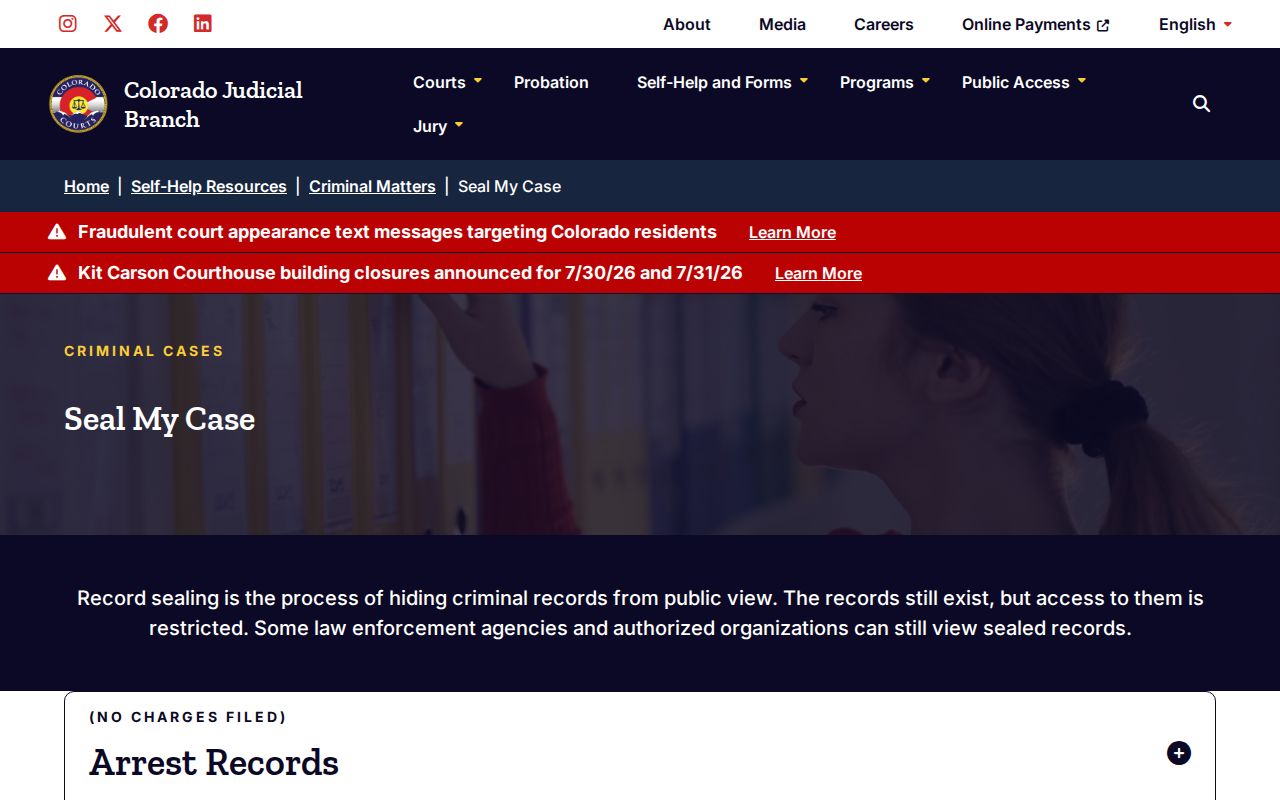
When a sealing order is entered, public access changes even though lawful government uses may remain.
El Paso County Court Scale
Fourth District materials describe the combined court as Colorado's largest in one facility. They report 24 district judges, with one assigned to Teller County, 11 county judges, with one in Teller County, and 18 magistrates. Fiscal year 2022 figures listed 23,078 District filings and 50,833 County filings. Those totals cover more than criminal matters, but they show why a precise case number and a narrow document request save staff search time.
Federal cases form another layer. El Paso County lies in the U.S. District Court for the District of Colorado, and the federal courthouse is at 212 N. Wahsatch Avenue. PACER, not the Fourth Judicial District clerk, holds the federal docket. Custody in the county jail can occur under a contract hold and does not by itself identify the prosecuting court.